
Landing page vs company profile website: choose by how customers buy
Use a landing page for one offer and a company profile website when buyers need to assess your company. Two questions, a catering example, page structure and how to measure results.
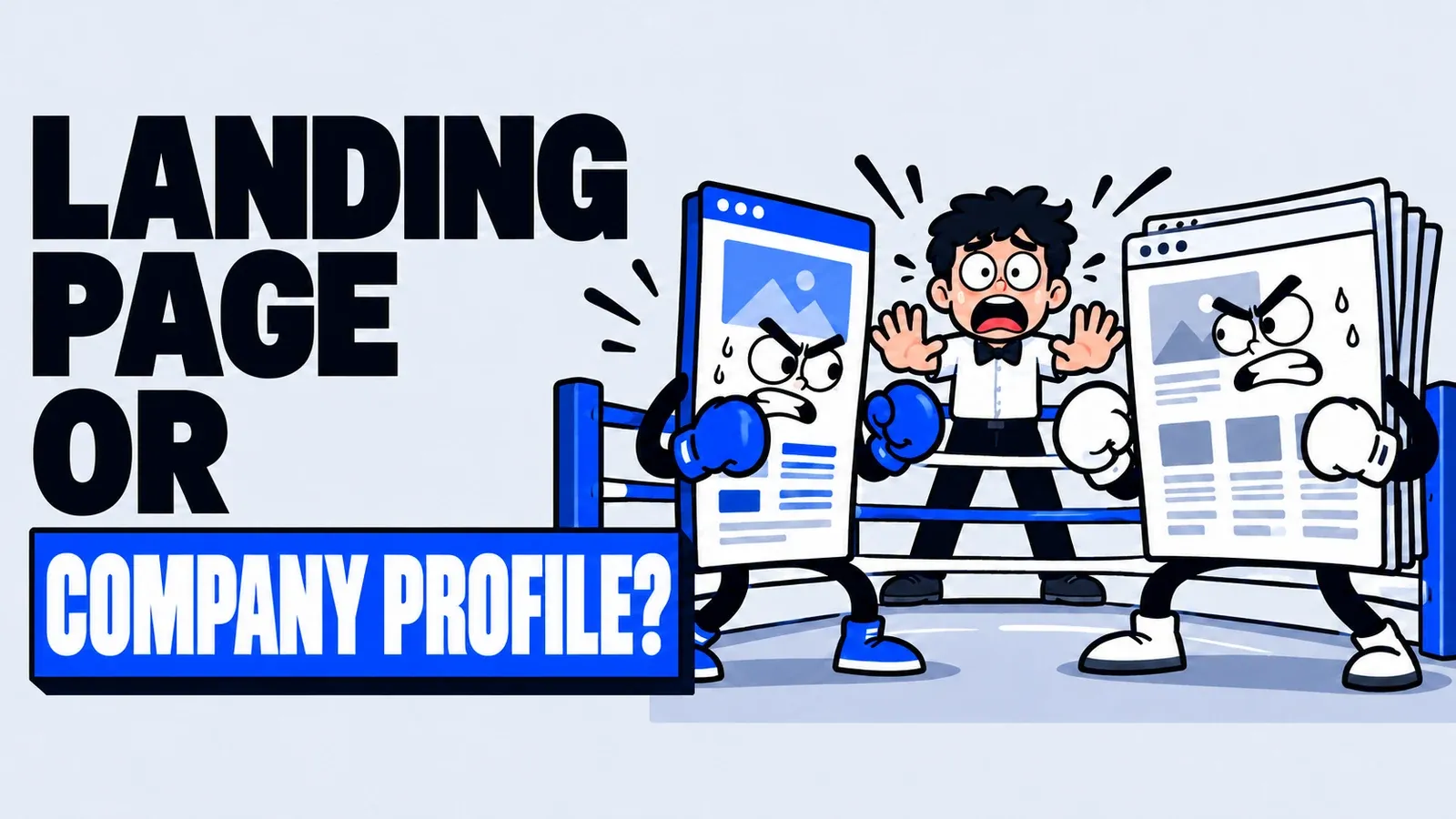
Table of Contents
Choose a landing page if visitors arrive for one offer and you want them to take one action, for example asking for the price of an office lunch package after clicking an ad. Choose a company profile website if prospective customers need to get to know your company and see several services before contacting you.
You do not have to pick just one, either. A company profile website can be your main site, with a particular campaign getting its own page on the same domain. The decision depends on where visitors come from, the question they arrive with, and what you want them to do after reading.
First agree on what "landing page" means
Google Ads defines a landing page as the page people end up on after clicking an ad. By that definition, a home page or a service page can also be a landing page. When people discuss a website project, the same term usually means a single page with one offer and one main action.
Because the meanings differ, say which one you mean when you ask for a quote. There are three possibilities, each with different design, content and measurement needs:
- a destination page for a particular ad campaign,
- a simple website that consists of a single page,
- an extra service page on an existing website.
How a landing page differs from a company profile website
| Landing page | Company profile website |
|---|---|
| The visitor's question | |
| Is this offer right for me, and how do I order it? | Who is this company, and can they meet my needs? |
| Content to start with | |
| One offer, its benefits in detail, relevant proof, terms and the main action | Profile, list of services, verifiable experience and contact details |
| Reading path | |
| Understand the offer, then get in touch or sign up | Explore company and service information, then send their requirements |
| Growth | |
| Another offer gets its own page if it really is different | Service, project or company information pages can be added |
| Judging the results | |
| Response to the offer and the quality of incoming requests | Visits to service pages and relevant requests |
Two questions that decide the choice
First question: do prospective customers need to assess your company or look at several services before getting in touch? Second question: do you have one offer with a clear source of visitors, such as an ad or a brochure? The two answers give four possibilities.

- Yes and yes: build a company profile website, then add a landing page on the same domain. For example, a catering company advertising an office lunch package.
- Yes and no: a company profile website alone. For example, a contractor that buyers assess through procurement and that is not running a campaign yet.
- No and yes: a landing page alone. For example, a course with one package promoted through ads.
- No and no: start with one short page covering your services, service area and contact details. Add pages when the need comes up.
Your answers decide what the site needs to say; the number of pages is flexible. One offer can be explained in several sections on a single page, and a company profile can start out short.
An example decision for a catering company
In this made-up example, a catering company serves office lunches, family events and meals for training sessions. Prospective customers need to see the service options, capacity, delivery area and how to request a quote. A company profile website with a separate page for each service can answer all of those questions.
When the same company advertises its office lunch package, the ad should lead to a dedicated page. That page explains the package types, ordering terms, service area and the details needed to prepare a quote, so visitors do not have to read past information about family events.

Also check that whoever manages the pages is ready to keep them current. If the menu and capacity change often and nobody updates them, a page that is too detailed soon goes out of date. Decide who checks the offer details before the campaign runs.
How to structure a landing page
- The offer, the target customer, and the area or limits of the service.
- The details needed to make a decision.
- Examples of work you have permission to publish.
- Ordering terms and the questions you are often asked.
- The main action, once visitors have enough information.
Campaign pages are often kept as simple as possible so visitors are not distracted. That is fine, as long as a route to other information remains. In a post from February 2025, Google said landing pages must be relevant and easy to navigate, and announced a new model that serves fewer ads leading to unexpected pages without useful navigation. So make sure visitors can still reach business information, contact details and relevant policies.
If you use the page for Google Ads, the same Google Ads Help page adds two points. The landing page must be on the same domain as the ad's display URL. Quality Score, Google's rating of ad quality, also weighs how useful the content is, how easy the page is to navigate, the number of links and how well the page matches what people expect when they click.
How to structure a company profile website
Start with a short profile, your services, projects or other proof of work, and clear contact details. Each service page should answer a distinct customer need. If you have only one simple service, there is no need to split it into many short pages.
If you sell through procurement, think about what buyers need to know before they talk to you: capabilities, scope of work, the contact details of the person in charge and suitable public documents. Do not publish documents or customer data that are not meant for the public.
How to measure the results of each
Decide which action to record before the page goes live. In Google Analytics, that action can be set up as an event and then marked as a key event. Read the numbers alongside the sales team's notes, because a button click alone does not prove that a conversation or a sale took place.
| What to record | Landing page | Company profile |
|---|---|---|
| Main action | A form submission or contact click for that offer | A form submission or contact click from a service page |
| Quality | Do incoming messages match the offer and the area? | Do incoming messages match the services you offer? |
A made-up example: a campaign page produces many WhatsApp clicks, but staff receive enquiries from areas the business does not serve. Check how clearly the page states the service area, and check the campaign's targeting. Adding the same button in more places does not solve this problem.
The company profile websites we build use a Go server for the public pages, Payload CMS running separately on plans with a dashboard, and Cloudflare in front, with no WordPress and no third-party plugins. The details are on our company profile website service page, and design examples are in the template gallery, where every business in the demos is made up. If you need a page for a campaign, explain the traffic source and the offer when you discuss our digital marketing service, so the page and its measurement are planned together.
Author
Dzaki Fauzaan